Mickey Haggerty
The Power of the DogMickey Haggerty is a small, silver-haired veteran whose quiet watchfulness makes him both a witness to Sean Callan’s past and a practical member of the crew that takes Callan in years later. He recognizes Callan when the latter enters a San Diego bar, remembers the killing that first brought them into the same room, and then helps coordinate the crew’s carefully rehearsed robbery of cash couriers. Mickey’s part is not to dominate the action but to worry over its contingencies, keep to the plan, and leave as little trace as possible.
Identity and Recognition
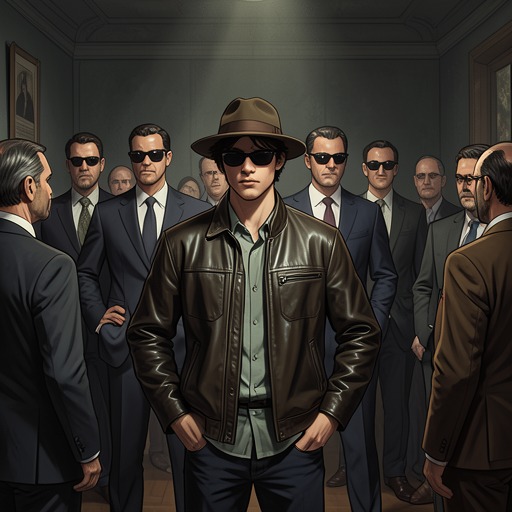
At the bar, Mickey is described as an old, small man with a cherub’s face and a full head of perfectly silver hair. He sits at the end of the counter, watching Callan over his whiskey while the other patrons turn back to their drinks. The comparison to a leprechaun perched on a toadstool makes his appearance memorable, but his attention is sharper than the comic image suggests: he recognizes Callan at once, including the familiar bulge at the small of his back where Callan still carries a pistol.
The recognition reaches back twenty years, to the Liffey Pub in Hell’s Kitchen. Mickey remembers Callan then as a boy who pulled a gun from his back and shot Eddie Friel twice. He also remembers the music: he had loaded the jukebox with repeated plays of Moon River because he wanted to hear it as often as possible before beginning another prison stretch. After the shooting, Mickey told the young Callan to throw the gun into the Hudson River. The song, the gun, and the two bullets make the old encounter vivid in his memory, even though Mickey has not seen Callan since.
Mickey has followed Callan’s rise indirectly, through what he has heard. He knows the story of Callan’s overthrow of Matty Sheehan, his peace with the Cimino Family alongside his friend, and his work as a hit man for Big Paulie Calabrese. He has also heard the rumor that Callan shot Big Paulie outside Sparks Steak House shortly before Christmas. When Callan does not recognize him, Mickey treats that imbalance as useful rather than hurtful: he finishes his drink and leaves to report Callan’s presence to someone who will want to know.
A Place in the San Diego Crew
Mickey is later identified as part of the crew Jimmy Peaches has assembled in San Diego. The group includes O-Bop, Jimmy Peaches, Little Peaches, and Mickey; Callan is the new addition. When Callan says he is finished with that life, Jimmy Peaches does not press him to settle the question immediately. Instead, he proposes getting Callan sober and fed, and has O-Bop find him clothes. The exchange positions Mickey as part of a settled local operation ready to absorb an old associate, while Callan remains uncertain about returning to criminal work.
The robbery preparations show the distinct function Mickey serves within that group. He does not ride alongside the courier car or take the most visible role in stopping it. Instead, he waits in a car at the Oceanside Transportation Center and thinks through what the crew should do if the couriers leave Interstate 5. His preferred response is to call off the attempt and wait for another opportunity; he knows, however, that Jimmy Peaches is unlikely to accept that option, so he also considers how they might infer the couriers’ route, get ahead of them, and choose a place to intercept them. He dislikes the improvised pursuit that this contingency would require.
Planning and the Courier Operation
Mickey’s caution persists even though the crew has practiced the alternative plan dozens of times. He imagines a traffic jam, a state trooper, an unseen backup car, or someone being shot. The sequence of possibilities becomes a measure of his temperament: preparation does not quiet his mind so much as give it more scenarios to test. Jimmy Peaches dismisses the worries with a blunt proverb, but Mickey continues to follow the operation’s timetable rather than abandon his role.
He makes the journey toward San Diego by separate forms of public transport, paying cash for a one-way Amtrak ticket and then buying a Greyhound ticket to Chula Vista. Afterward he returns to his car and waits. The transfers, cash payment, and careful lack of visibility fit the crew’s larger effort to keep its members dispersed and difficult to connect to the robbery. Mickey’s attention to small details extends to the ordinary cover of leaving a restaurant: he pays the bill and a deliberately moderate tip, not wanting to be remembered for either stinginess or excess.
Before driving to his assigned position, he takes a gun from the glove compartment, checks its load, and straps it into an ankle holster. All the bullets are still there, as he expects, but he checks anyway. The habit reflects a fear Jimmy Peaches has of reaching for a gun and hearing only the dry click of an empty chamber. Mickey then takes his place at the Oceanside Transportation Center as the other members spread along the route: Little Peaches near Calafia Road, Jimmy Peaches at the Ortega Highway exit, Callan on his motorcycle near Dana Point, and O-Bop following the courier car.
As the operation proceeds, O-Bop reports that the couriers are in a blue BMW, gives its license number, and says there are three men and briefcases in the trunk. The briefcases mean the crew will have an additional step after stopping the car. Mickey has made them practice for that possibility, but the detail also shows why his worry is not merely abstract: plans must account for what the crew will find and what it will need to do next. When Callan signals that he is on the highway, Mickey starts a new timer. He stays away from the immediate violence, but his clock gives the operation a shared measure of time.
Withdrawal and Narrative Role
After the robbery, the crew converges on the transportation center and disperses again. Mickey waits in his car, watching the clock as the remaining time runs down. Callan and O-Bop arrive in short hair and deliberately poor off-duty Marine clothes, collect tickets, and board separate buses; Jimmy Peaches and Little Peaches also use separate journeys and changes of clothes to break up their routes. Mickey simply drives back to his hotel. He has not been close to the action, and, if the police question him, he intends to say nothing. He drives at the downtown speed limit and goes back to bed for a nap.
Mickey’s scenes connect two criminal generations without turning him into the center of either story. At the bar, his memory gives Callan’s return a long shadow: Callan is not merely a man who has arrived in San Diego, but the armed boy Mickey last saw after Eddie Friel was killed. During the robbery, Mickey’s habits of rehearsal, timing, concealment, and withdrawal make him a counterweight to the more impulsive pressure of the operation. His recurring watchfulness—over Callan, over possible routes, and over the clock—shows how the crew manages danger through both practical preparation and persistent unease.